Try to take a real week off. Not the kind where you still answer messages from a beach chair. A real one, phone in a drawer.
For a lot of owners, that is not a vacation. It is a stress test the business quietly fails. The orders still come in, but nobody knows which client gets the rush job. The new hire freezes on a step only you know. By Wednesday someone texts you a photo of their screen, asking what to do next.
If that feels familiar, here is the blunt version. You do not own a business. You own a job that cannot run without you in the room.
The pattern underneath all of it
Every one of those stalls traces back to the same place. The business runs on one person's memory, and that person is you. How the work actually gets done lives in your head, not in any document a team could open and follow.
That is fine when it is just you. It becomes the ceiling the second you want to grow, because the company can only ever be as big as what you can personally touch.







Seven signs you are the bottleneck
We put these on a checklist because owners tend to recognize themselves before they reach slide three:
- Work stops when you step away. A sick week or a real vacation, and the whole thing stalls.
- The answer is only in your head. How the work gets done lives in your memory, not in writing.
- Every decision waits for you. Nobody moves without your sign-off, so work piles up behind one person.
- Onboarding means shadowing you. Nothing is written down, so every hire learns by watching you for weeks.
- You do work a checklist could do. The same task, the same way, every week, handled by the most expensive person in the building.
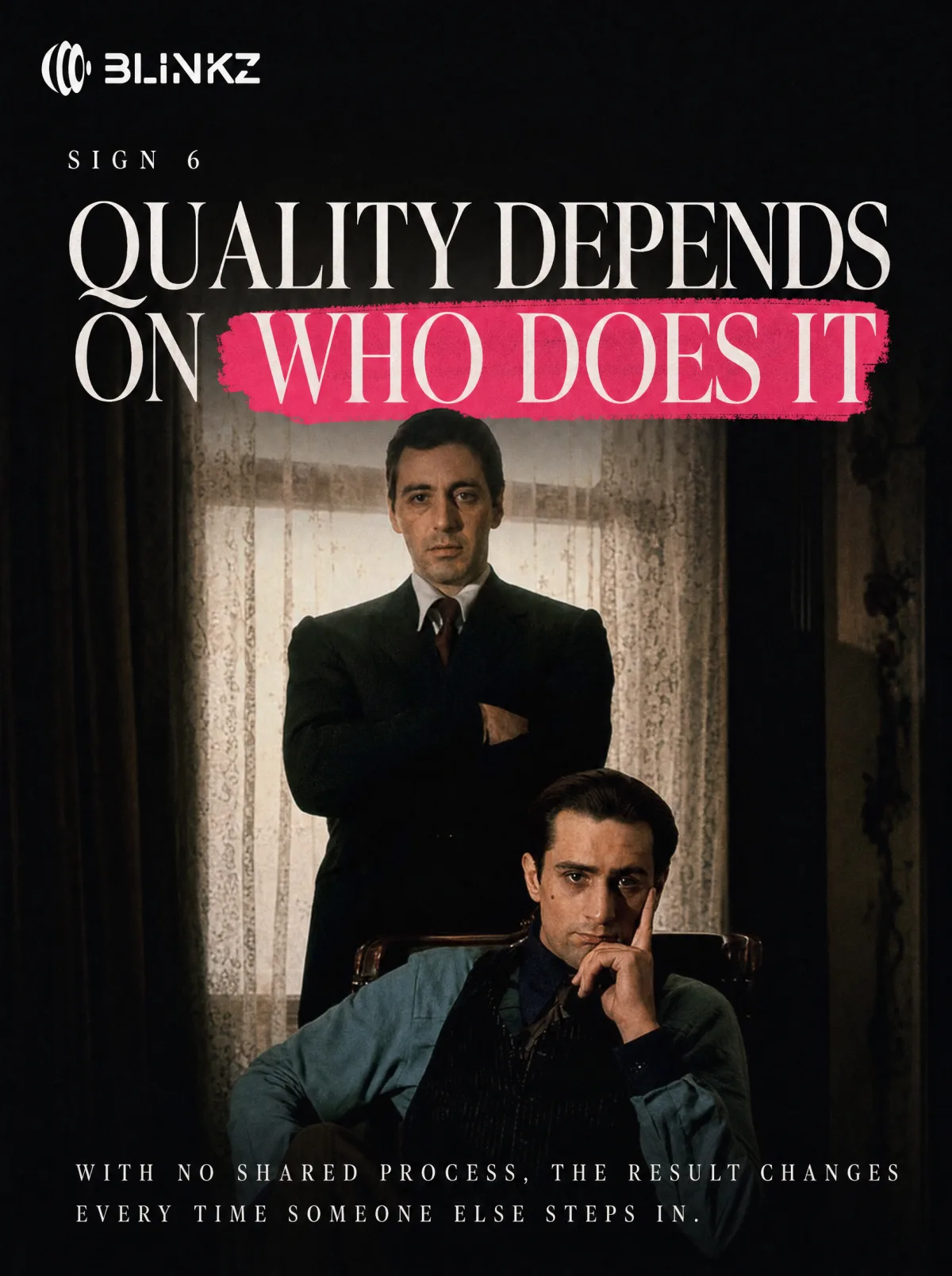
- Quality depends on who does it. With no shared process, the result changes every time someone new steps in.
- If you vanished for a month, would it survive? That is the whole test. If the honest answer is no, the other six are just detail.
Notice that none of these are about working harder. You already work hard. That is the trap: the harder you work, the more the business learns to lean on you, and the deeper the hole gets.
It is a bottleneck problem, not a growth problem
Most owners read this and reach for the wrong fix. They try to hire. But handing work to someone without handing over the system just buys you a second job, doing the work that lives in your head while also managing the person trying to read your mind.
The real fix is unglamorous. You map how the business actually runs, once. You write down the parts that only exist in your memory. Then you let a system carry what your head carries today, so the next decision does not have to wait for you to be awake.
That is the whole point of an operations audit. Not software, not a reorg. Just making the business legible enough that it can run a week without you, and then a month.
If you want the checklist we use to find every bottleneck, that is the free teardown. If you would rather talk it through, the free Health Check is thirty minutes to find where yours is stuck.